
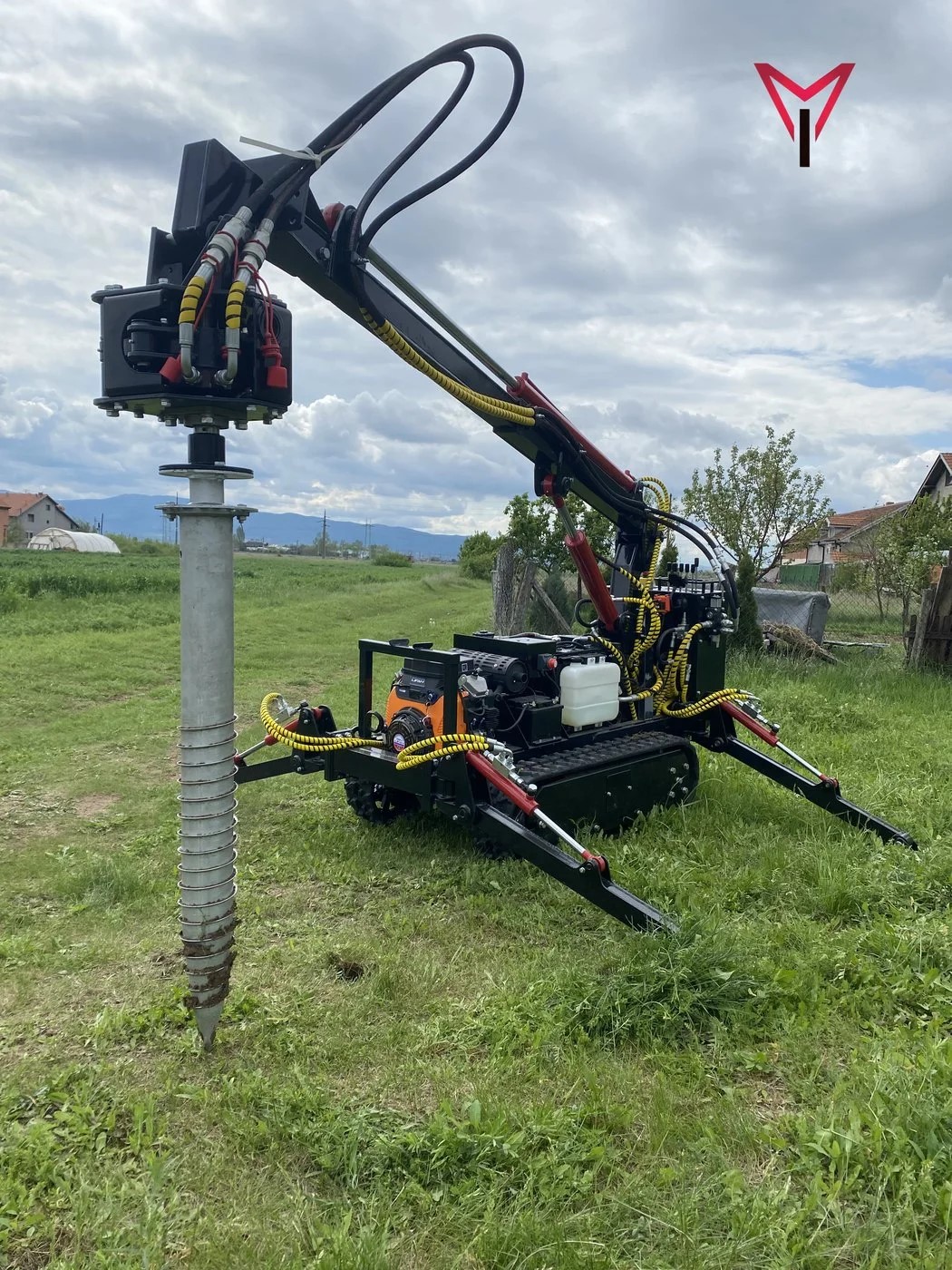
How Helical Pile Machines Work on Construction Sites
Helical piles are installed by rotation rather than by impact or conventional excavation. Their steel shafts carry one or more helical plates that advance through the soil as torque is applied from above. The process may look straightforward, but reliable installation depends on several factors working together. The machine must position the pile correctly, keep it aligned, provide sufficient rotational force and remain stable while soil resistance changes. This makes the installation equipment an important part of the foundation system rather than merely a source of power.
A dedicated machine combines these functions in one working platform. An example of this type of equipment can be seen at https://iron-mechanics.com/product/helical-pile-machine/, where a tracked self-propelled design is used to position and drive helical piles. Machines of this class allow the operator to approach each foundation point, align the drive head and apply controlled torque without relying on a full-size excavator. Their practical value is especially noticeable on projects where pile installation is repeated many times or access is limited.
From Marking the Site to Starting the Pile
Pile installation begins with setting out the foundation points according to the structural design. Position accuracy matters because the upper structure will later connect to these supports. If a pile is installed too far from its intended position, beams, brackets or structural frames may require modification. Correcting the layout before installation is considerably easier than adapting the structure afterward.
The machine is then moved into position so that the drive head can be aligned with the pile axis. The pile must enter the ground at the intended angle, which is commonly vertical but can differ in specialized applications. Even a small deviation near the surface can become more noticeable as the pile advances deeper into the soil. Stable machine positioning helps the operator prevent this movement.
The initial stage usually requires controlled rotation rather than maximum power. The pile needs to establish its path before greater resistance develops. Operators monitor its position while the helix begins to pull the shaft into the soil. If adjustment is necessary, it is easier to make while only a short section of the pile has been installed.
Once the pile is established correctly, the machine can continue applying torque while maintaining the required alignment. Soil resistance generally changes with depth, so installation is not a perfectly uniform operation. The operator needs to respond to these variations rather than treating every meter of penetration in the same way.
Why Hydraulic Torque Is Used
Helical pile installation requires high rotational force at relatively low speed. Hydraulic systems are well suited to this combination because they can deliver substantial torque while allowing controlled movement. Unlike a high-speed drilling process, the objective is not to rotate the pile as quickly as possible. The goal is to advance it steadily while maintaining control over both the machine and the foundation element.
Torque demand depends on pile geometry and ground conditions. Larger diameters generally require more force, while dense soil layers can increase resistance significantly. A machine therefore needs enough capacity not only for normal installation but also for harder sections that may appear unexpectedly. Working continuously at the absolute limit of a drive system leaves little reserve for these conditions.
The hydraulic drive must also remain controllable. Sudden changes in speed or excessive force can make alignment harder to maintain. Smooth torque application allows the operator to observe how the pile behaves and respond before a small positioning error becomes difficult to correct.
Hydraulic pressure and flow are both relevant to machine performance. The complete system includes the pump, hoses, valves, drive motor and other components that must operate together under repeated load. For professional contractors, durability and ease of service can therefore be just as important as the headline torque figure.
What the Machine Has to Control
A helical pile machine performs several tasks during each installation cycle. These functions need to remain coordinated because a weakness in one area can affect the quality or speed of the whole operation.
The main requirements include:
- positioning the drive head over the planned foundation point;
- keeping the pile aligned as it enters deeper soil layers;
- generating enough torque for the selected pile dimensions;
- remaining stable while rotational resistance increases;
- allowing the operator to reach the required installation depth;
- moving efficiently between separate foundation points.
These demands explain why machine design involves more than installing a powerful hydraulic motor on a mobile chassis. Reach, stability, boom geometry and undercarriage configuration all influence how effectively available torque can be used. A machine that produces high torque but cannot hold the pile in a stable position may still be inconvenient on demanding projects.
The same applies to mobility. Construction sites rarely provide perfectly level, open working areas. Equipment must often move between buildings, along narrow access routes or across unprepared surfaces. A practical pile machine therefore needs to balance installation capacity with the ability to operate in these real site conditions.
Working With Different Pile Sizes
Helical piles are produced in different shaft diameters, lengths and helix configurations because foundations carry different loads and encounter different soil conditions. Installation equipment must accommodate this range without making every project unnecessarily complicated. Drive adapters are typically used to connect the machine to the chosen pile system.
Larger piles normally place greater demands on the drive unit and the machine structure. They may also be longer and heavier, which changes the way they need to be positioned before installation begins. A machine suitable for small residential piles is not automatically appropriate for larger foundation elements used in heavier structures.
Length creates another practical consideration. A short pile can be handled relatively easily in an open area, while longer sections require sufficient overhead and working clearance. Boom reach and movement become increasingly important as pile dimensions grow. Restricted sites may require the crew to plan installation order carefully so the machine always has enough room to position the next element.
Some pile systems also use extensions. In these cases, the first section is driven to a specified point, another shaft section is connected, and installation continues. The equipment needs to support this workflow without forcing the crew to reposition the entire machine unnecessarily.
Why a Tracked Chassis Can Be Useful
A self-propelled tracked machine offers a different operating model from an excavator fitted with a torque head. The installation unit is already integrated into its own mobile platform and can move from one pile location to another as part of the normal work cycle. This can simplify small and medium projects where renting a separate excavator would add another layer of transport and scheduling.
Tracks can provide useful traction on uneven construction surfaces and spread machine weight across a relatively broad contact area. This does not mean that ground damage is impossible, especially on soft or wet soil. Contractors still need to assess access routes and use protective mats where required. The advantage is that the machine is designed to remain mobile on sites that may not have finished roads or hardstanding.
Compact dimensions can also help when working around existing structures. Residential extensions, decks and modular buildings are often constructed in locations where open working space is limited. A machine that can approach individual pile points without large swing requirements may reduce the amount of site preparation required solely for equipment access.
Mobility also affects productivity. If repositioning between piles takes only a short time, more of the working day can be spent on actual installation. This becomes increasingly important as the number of foundation points grows.
Soil Resistance Changes During Installation
The ground beneath a construction site is rarely uniform. A pile can pass through relatively soft upper layers and then encounter dense clay, gravel or another material with much higher resistance. These transitions are normal, but they influence torque and installation speed. Operators need to recognize that a change in machine behavior can reflect a change below ground.
Unexpected resistance can also indicate an obstruction. Continuing to apply force without understanding what is happening may damage equipment or push the pile away from its intended path. Depending on the project, the operator may need to stop, reassess the location or consult the engineer responsible for the foundation design.
Installation depth should therefore not be treated as the only measure of success. The relationship between depth, torque and the specified pile design can provide useful information about the conditions encountered. On engineered projects, installation records may be required to document this process.
This is another reason why controlled machinery is preferable to simply maximizing installation speed. The operator needs enough feedback to understand what is happening as the pile advances. Predictable machine response makes that judgment easier.
A Machine Is Part of a Larger Foundation Process
Even specialized equipment cannot compensate for poor project preparation. Pile locations must be planned, underground services checked and suitable foundation elements selected before installation begins. Access routes need to be prepared, and the crew should know how finished pile positions will be verified. Efficient installation is the result of combining appropriate equipment with an organized site process.
Operator skill also remains important. Hydraulic power reduces physical effort, but it does not replace judgment. The operator needs to understand alignment, machine stability and changes in soil resistance. Experience also helps crews decide how to position the machine so that the next pile can be installed with minimal unnecessary movement.
Maintenance influences productivity in the same way. Hydraulic hoses, fittings, drive components and moving parts work under repeated load. Routine inspection reduces the risk of failures that can stop an entire foundation crew. For contractors that depend on one installation machine, preventive maintenance can have a direct effect on project scheduling.
A helical pile machine works effectively when power, control and mobility are balanced. Torque drives the foundation element into the soil, but positioning and stability determine whether that force is applied accurately. On suitable projects, dedicated equipment gives contractors a controlled way to install multiple foundation points without organizing extensive excavation or bringing larger machinery to every site.